Page 5 of 6

Testimonial from Alex Ferguson, of Freight Negotiate

I often receive testimonials from clients when completing a job for them – but I never actually post them anywhere in the public domain. So this is definitely something I’m going to be doing more often.

I recently developed a website for a company called Freight Negotiate. Alex Ferguson, Managing Director, approached me with a vision of exactly what she wanted. Freight Negotiate was to be a modern and dynamic platform that allows companies to ship their products around the world by allowing various hauliers to bid on shipments, resulting in cheaper rates for shippers and more work for hauliers.

After various email discussions and a meeting, Alex decided to move forward with the project. When Freight Negotiate launched recently, Alex had the following to say:

I am really impressed with the site and to produce something this good in such a short space of time is phenomenal. It has been a pleasure working with you and I certainly look forward to growing the business with the aid of your web development skills in the near future.

Freight Negotiate launched with the following features:

  • Instant messaging
  • Live bidding
  • Advanced search functions
  • A dynamic payment system (including 30 day credit applications)
  • Free registration
  • Secure SSL
  • Simple shipment management
  • And so much more!

I wish Alex and Freight Negotiate great success in the future.

Every year, the services we use every day on the web tend to play tricks on us when it comes around to April Fools Day. Whether it be “announcing a new feature”, or “testing something out”, you’ll usually find that Google, YouTube, and Amazon alike have something in-store for us all. So this year, I’ve decided to search the web for the best pranks from the services we use on a daily basis.

Google Maps Pac-Man

google-maps-pac-man


If you head on over to Google Maps today, you will notice the new Pac-Man mode at the bottom of the screen (where Earth/Terrain view can be toggled). You can simply navigate to an area of your choice around the world, toggle Pac-Man mode and play for hours. Pretty cool eh?

Amazon’s Dash Button

I’m not too sure how I feel about this one, but I’m pretty sure this is an April Fools joke. Let’s say it’s 11pm and you’re making a cup of tea and realize you’re on the last tea bag (and you can’t be bothered to go out and get any more in the morning), well not a problem at all with Dash. Just click the Dash Button on your pack of teabags to automatically order some more. Welcome to the innovative world of Amazon! Watch the video below…

*note, for Prime members only

Samsung Galaxy BLADE Edge

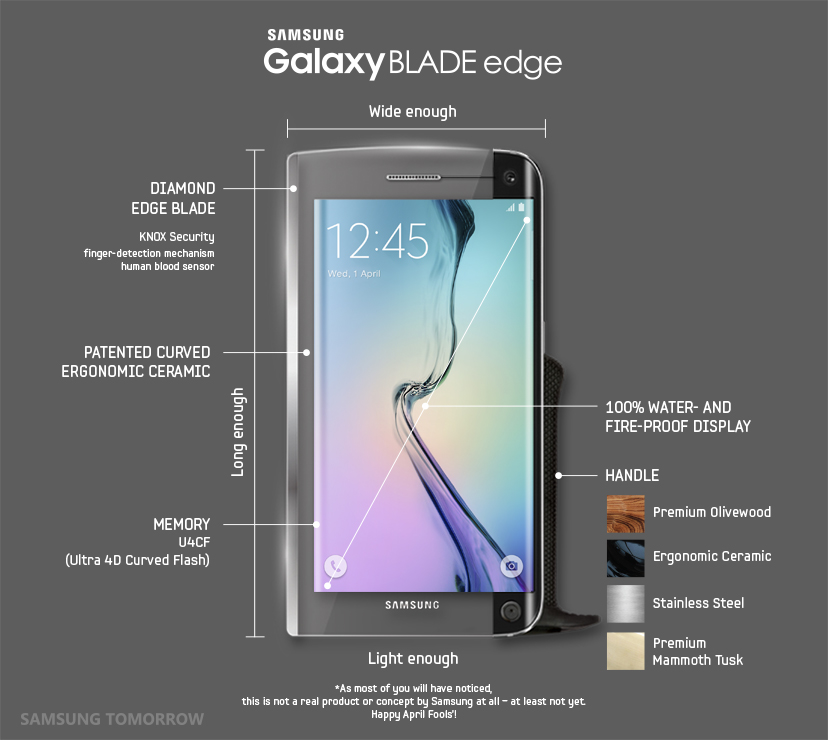
Samsung have announced that they are extremely proud to introduce the world’s first smart knife, the Galaxy BLADE Edge. It’s safe, waterproof, fireproof, and even has a built in thermometer – quite a sweet innovation. It’s kitted out with Samsung’s Kitchen app, which automatically connects the device to other Samsung kitchen appliances to automate cooking. Custom handles are also available.

blade_spec

Google Reverse

Google are a company who think ahead of our time to create innovative products and services that we should find useful; so they’ve introduced Google Reverse over at com.google.

Windows Phone’s MS-DOS

Back in the day, before a graphical user interface was present on operating systems, Microsoft users had to be familiar with MS-DOS to get things done. Today, it looks like Microsoft are bringing MS-DOS into the mobile market. Download the app here.


What’s responsive design and why is it so important?

We live in a world of smartphones, tablets, and thousands of different devices – all with different screen sizes. As a web developer, it’s my job to keep up with the trend and ensure websites I build adopt this responsive strategy.

What is responsive design?

Responsive web design (RWD) is an approach to web design aimed at crafting sites to provide an optimal viewing experience—easy reading and navigation with a minimum of resizing, panning, and scrolling—across a wide range of devices (from desktop computer monitors to mobile phones).

Wikipedia

As Wikipedia states above, responsive design ensures that your website is optimized for all screen sizes, ranging from desktop computers, to tablets, to smartphones.

It also works as one website. For example, years ago when visiting a website on your desktop computer you’d remain on www.domain.com. However, if you was to visit that website on your phone, you’d be redirected to m.domain.com – a completely seperate website built specifically for smartphones. Today though, if you was to visit a website that’s responsive on you computer and drag the browser window down in size then the website would adapt to the new screen size – this is a prime example of responsive design and how it works.

Why is responsive design so important?

As previously mentioned at the beginning of this article, there are thousands of variations of different devices out there, all varying in size. As there is no standard width for a smartphone or tablet, it becomes more and more practical to have a responsive website by the day.

Future proof

Making your website responsive not only makes it look good on phones, it also makes it futureproof. Not only will it work well on devices which are currently on the market – it will also work on devices to come for a number of years.

It’s more SEO friendly

Did you know Google are now using responsive design as a ranking factor? If your website is responsive and your competitors isn’t, then you have one over on them when people are searching for your services or products.

Cost effective

Building a mobile version of a website would probably double your design and development costs – as effectively two websites are being designed and developed. However, responsive design is part of the same website. You only ever have one website which adapts to screen size. While some freelancers/agencies charge for responsive web design as an optional extra, others (like myself) include it as a standard.


Everyday, more and more websites go responsive. If yours is not yet responsive, then now is a good time to consider it. If you’re looking to get a new website developed, then ensure it’s responsive too.

Update: March 2015

As of April 21st 2015, Google will be penalizing websites that aren’t mobile friendly in mobile search results. Get a responsive website now.

Update: April 2015

Read more about mobile websites at Google Developers. Here, you can check if your website is already mobile friendly, read best SEO practices, and more. – Thanks to Thomas Digby.

Quote of the day – 17th October 2014

The biggest risk is not taking any risk… In a world that changing really quickly, the only strategy that is guaranteed to fail is not taking risks

– Mark Zuckerberg

8 Reasons Why You Shouldn’t Use a Website Builder

A lot of websites I come across are often built with free (or cheap) and nasty website builders. Why? Because people think they are getting a top of the range website for no more than £15 per month. But they’re wrong. Here’s a list of 10 reasons as to why you shouldn’t use a website builder…

1) You don’t own the website

When using a website builder, you don’t actually own the website you create. The company who operates the service you are using own the website.

2) SEO tends to be a no no

Website builders do almost nothing to optimize your website for search engines. The structure of the content they produce is poor, and no care seems to be taken when a website is generated. Not forgetting that a lot of site builders use Flash, which Google cannot read or index.

3) Poor designs

Despite the fact that website builders offer hundreds (or even thousands) of ready made templates, they all tend to look like they’ve been stolen from Microsoft Powerpoint’s template directory. They are old and amateur.

4) A website can be built in 30 minutes

Seriously, it takes longer to bake a cake, or cook your dinner. If you value your business or organisation, then surely you’d put more time, effort and money into the website that will represent you. A website is usually the first thing people see before contacting you. It has to reflect that you offer a quality service or product, and that you are professional.

5) You don’t have a proper domain name

Is a web address such as mybusiness.webs.com really that professional? I think not. Your website needs to be at a memorable domain, such as mybusiness.com.

6) Adverts

Is having “THIS WEBSITE WAS CREATED BY 1&1 MY WEBSITE” plastered all over your website ideal? Just think about it…

7) You’re paying forever

So £30 per month seems cheap, right? Total that up for a year. Or even 3 years. It’s not so cheap afterall. Yes you will find plans that start off free (or at a discounted rate), but they do not stay free forever. There’s not a lot of free things in the world today.

However, if you was to hire a professional web designer or web developer, then you’d end up paying a one off fee that usually costs less than your site builder fees.

8) They don’t care

The people who make these website builders do not value your business and they do not care about your success. However, an agency or a freelancer works with you for as long is possible to ensure you get the success that you wish for.

Why I started blogging…

Often I sit on a train, travelling to various places of work. Whether it be Adventure, GardenSite, or elsewhere – there’s a good chance I’ll be bored during my journey. I spend an average of 1.5 hours on a train on a typical working day (Monday to Friday) – and I feel like I’m wasting every minute of that time. So I wanted to do something productive. So I thought I may as well start blogging.

I could always do some web development work, but writing code from my phone isn’t the easiest of tasks.

A blog also gives me a place to share the things I find interesting and a place to share my thoughts on various topics that interest me.

I plan to publish a post daily, but how possible that is depends on how busy the train is.