Category: Education

Every year, the services we use every day on the web tend to play tricks on us when it comes around to April Fools Day. Whether it be “announcing a new feature”, or “testing something out”, you’ll usually find that Google, YouTube, and Amazon alike have something in-store for us all. So this year, I’ve decided to search the web for the best pranks from the services we use on a daily basis.

Google Maps Pac-Man

google-maps-pac-man


If you head on over to Google Maps today, you will notice the new Pac-Man mode at the bottom of the screen (where Earth/Terrain view can be toggled). You can simply navigate to an area of your choice around the world, toggle Pac-Man mode and play for hours. Pretty cool eh?

Amazon’s Dash Button

I’m not too sure how I feel about this one, but I’m pretty sure this is an April Fools joke. Let’s say it’s 11pm and you’re making a cup of tea and realize you’re on the last tea bag (and you can’t be bothered to go out and get any more in the morning), well not a problem at all with Dash. Just click the Dash Button on your pack of teabags to automatically order some more. Welcome to the innovative world of Amazon! Watch the video below…

*note, for Prime members only

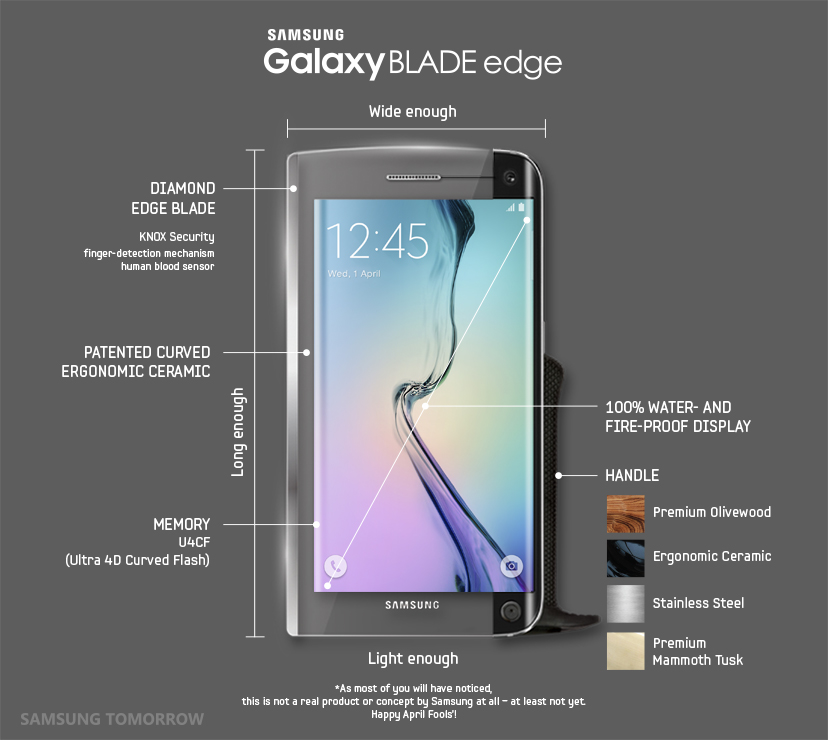
Samsung Galaxy BLADE Edge

Samsung have announced that they are extremely proud to introduce the world’s first smart knife, the Galaxy BLADE Edge. It’s safe, waterproof, fireproof, and even has a built in thermometer – quite a sweet innovation. It’s kitted out with Samsung’s Kitchen app, which automatically connects the device to other Samsung kitchen appliances to automate cooking. Custom handles are also available.
blade_spec

Google Reverse

Google are a company who think ahead of our time to create innovative products and services that we should find useful; so they’ve introduced Google Reverse over at com.google.

Windows Phone’s MS-DOS

Back in the day, before a graphical user interface was present on operating systems, Microsoft users had to be familiar with MS-DOS to get things done. Today, it looks like Microsoft are bringing MS-DOS into the mobile market. Download the app here.


The Future of Technology In Education

10 years ago, very few people had Internet connection, and those that did couldn’t use their telephone at the same time and they probably connected to it via a “chunky” computer with a large “chunky” monitor, and yes, it would’ve been really slow. Today, we have tablet computers, smart phones, smart watches and so on, not to mention Google Glass (Google’s new device which really does make things pop up in front of you).

The question is though, what will we have in the next 10 years? That isn’t something I really want to be thinking about, it’s just overwhelming.

Some people forget about the progression within the education industry though; not only in the UK but around the world. There were days numerous years ago when a lot of schools had about five computers, which would take hours boot up and everyone would have to take turns to use them. Today in some schools, colleges, academies and other educational institutions, there”s a computer for every 3 students. Some even provide students with their own laptop or tablet computer.

So currently, we have devices such as the interactive white boards (also known as SMART boards), educational games, electronic paper screens, tablets, online progress and monitoring, video lessons, online communities, educational app stores, cloud-based learning, open source development tools, student-developed apps and much more. Most of these are used in public and private learning today, all of which are used at some point somewhere; all of which have started to appear in recent years.

Let”s imagine the year 2020, which is about 7 years away – not too long. What technology will be within the education industry then?

Predictions have already been made and I can almost definitely say that most, if not all, of these will become true at some point. For a start off, 3D printers are already starting to make an appearance, so that”s definitely one thing which we will see in classrooms of the near future. Another thing which is starting to make an appearance is self-paced learning, where students are sent off to work at their own pace, but are still being monitored by technology.

Now onto things which haven”t really started to make an appearance yet, but are still yet predicted to by 2020. The first thing will be desk-sized monitors. Obviously this is something that is very possible and will propose as one of the most useful tools in the classroom. This monitor would be able to digitally provide a student with everything they need and allow them to digitally complete a task and get it instantly marked, also allowing the teacher to monitor their progress. Smart assessment algorithms will be able to mark any work submitted.

Furthermore, another thing is eye tracking. Every device will track the movement of your eyes, and with this movement tracking, a student or teacher will be able to interact with screens and digital activities. One of the many other features which will be present in the future technology involved in education is attention tracking, which records how much attention a student is paying to a particular topic or task – reporting feedback back to teachers. I personally think that attention tracking will be an extremely useful tool.

Education will continue to grow and develop around the world. Remember though, this doesn’t include the mobile device progression, wall-sized screens, auto-generated lessons, reactive furniture, holography and eyewear which could also possibly make an appearance.

This is the point where IT will not be considered as a standalone subject which it currently is, it will disperse and be involved in every skill, tool and facet of the classroom. This is also the point where as classrooms digitize, students will become free to collaborate with peers globally.

This is just a small summary of what’s to come of the technology involved in education by 2020. Just imagine the impact it will have!

Copyright © 2026 James Dowen